

Next week, I’m presenting at the Bureau of Digital’s Ops Week on something called “Managing Risk in Modern Agency Operations.” I’ve been refining the slides for weeks, walking agency leaders through how to anticipate threats, assess what matters, and adapt before things blow up.
And while I was preparing this presentation, I realized something uncomfortable: I’m really good at using these frameworks to avoid bad outcomes in my creative business. But historically I’ve been pretty terrible at using them to pursue opportunities.
Let me show you what I mean.
The Decision I Got Right
A few years ago, I faced a choice that trips up a lot of creatives: how to sell my work.
The prevailing wisdom was clear—build your own website, sell direct, own the customer relationship. Don’t send people to print-on-demand platforms where they’ll get bombarded with your competitors. Keep them on your site. Make more profit per item.
It’s not wrong advice. The logic is sound. So I followed it.
I set up my own website. Connected it to Printful. Listed my favorite designs. Shared it with friends and family. Got a few sales.
Then the emails started.
“Hey, my order hasn’t arrived yet—do you know what’s up?”
These were people I knew and loved, asking perfectly reasonable questions. And I found myself frustrated. Not at them—at the situation. If I was finding it this annoying when it was just my mom asking about her order, what would happen when I had dozens of customers I didn’t know?
The breaking point was clear: I didn’t want that part of the business. I wanted to make the art. That was it.
Here’s where my ops brain kicked in. The standard creative business advice was asking me to take on a specific risk: that customer service and fulfillment logistics would consume the limited time I had available for creative work.
Let me be clear about my constraints: I run a full-time consulting business. K Bedford Consulting pays my bills. My creative work—Nomadic Raconteur—fills my soul. I have maybe 5-10 hours a week for art-related activities. If I spent those hours answering shipping questions and managing print vendor relationships, when would I actually illustrate?
So I did what I do in my ops consulting work: I stopped treating it like a moral decision and started treating it like a comparison. For each option, what’s the likelihood something will go wrong, and how big of a problem will that actually be?
Option 1: Sell through my own website with Printful
Problem: Customer service issues pulling me away from billable work and art creation
Likelihood: High (it was already happening with just friends and family)
Impact: High (time is my scarcest resource; every hour on customer service is an hour not consulting or creating)
Option 2: Sell through Redbubble/TeePublic
Problem: Lower revenue per item and less control
Likelihood: Guaranteed (this is just how these platforms work)
Impact: Low (losing $5 per item matters way less than losing 5 hours per week)
When you lay it out like that, the choice of which risk to avoid becomes obvious. High likelihood + high impact beats guaranteed + low impact every time.
So I moved everything to print-on-demand platforms and stopped second-guessing it. The platforms handle returns, reprints, shipping complaints, all of it. I protect the time I need to actually create.
This is threat management. I identified what could sink my creative practice and I actively worked to prevent it. Gold stars for me.
You Can’t Stop the Waves
There’s a quote from Jon Kabat-Zinn that’s become the centerpiece of my Bureau presentation: “You can’t stop the waves, but you can learn to surf.”
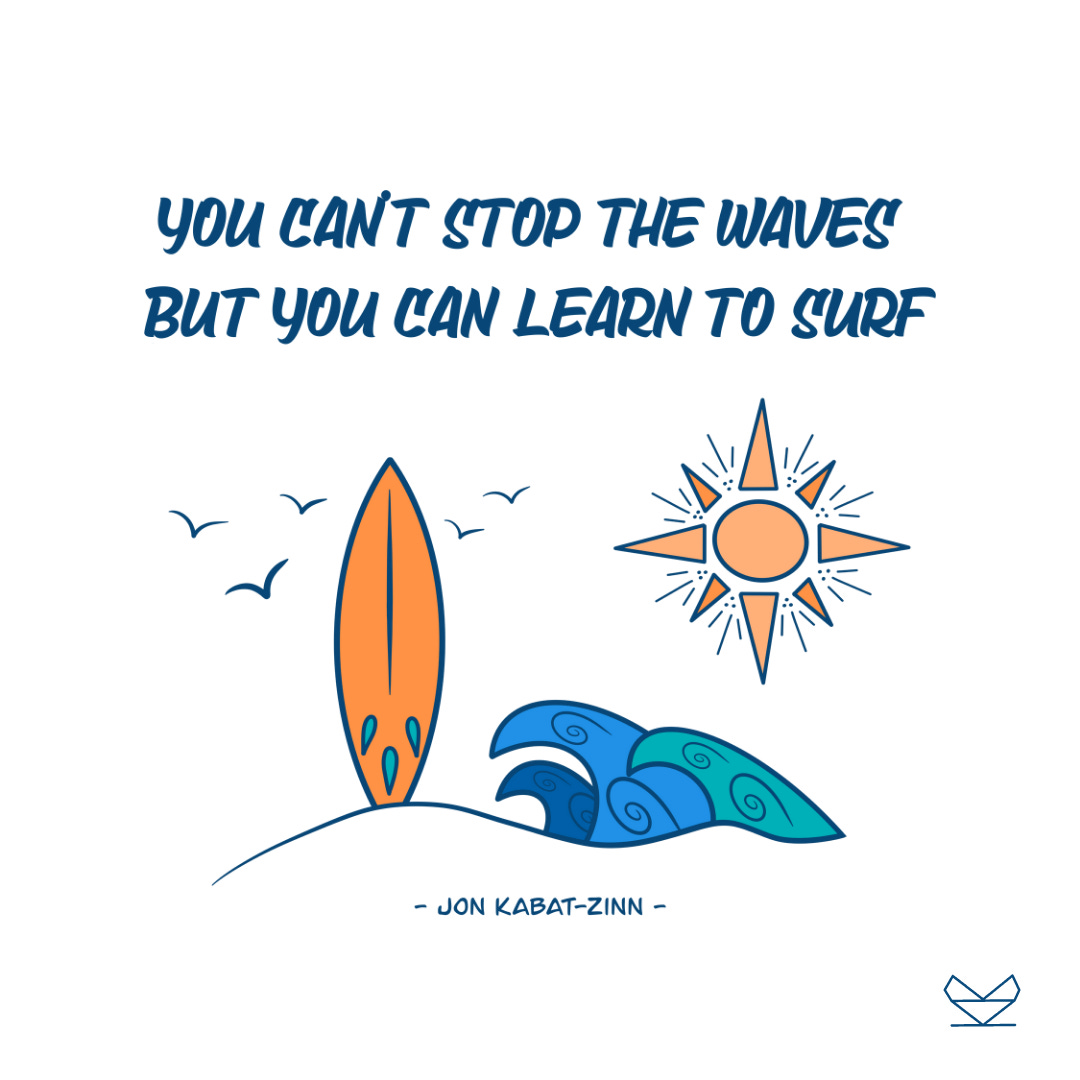
In both agency operations and creative businesses, some challenges are inevitable. You can’t prevent them from happening—client budgets shift, technology disrupts pricing models, customer service demands pile up. What you can do is get better at recognizing them early and making strategic choices about how to respond.
That’s what I did with print-on-demand. I saw the customer service demand coming, assessed the impact, and made a strategic move to transfer that risk before it consumed me. I thought I had this figured out, until building my presentation forced me to confront what I wasn’t doing.
The Decision I Keep Avoiding
I’m excellent at identifying threats. I see what could capsize my creative practice and I navigate around it or hand it off to someone else. I protect my creative time ferociously. I’ve eliminated everything in my art business that doesn’t directly serve the actual making of the work.
But opportunities? I haven’t exactly been great at capitalizing on those.
Right now, the biggest opportunity in my creative business is licensing deals. Redbubble and TeePublic are great for proving there’s demand, but I’m never going to sell the volume through those platforms that I could through licensing arrangements. This is the obvious lever to pull. The highest impact move available to me.
So why haven’t I pursued it? Great question. I couldn’t actually answer this question, so I made myself do a risk assessment of this opportunity. Let me run you through it.
Pursuing licensing deals:
What could go wrong: Time investment in both research and outreach, facing rejection
Likelihood: High (this will definitely require effort and I’ll definitely hear “no” more than “yes”)
Impact: High (this is the path to my actual goal—passive income in retirement doing something I love)
NOT pursuing licensing deals:
What could go wrong: Stay at current revenue ceiling, miss the window while designs are trending, never build the retirement income stream I want
Likelihood: Guaranteed (if I don’t pursue it, it definitely won’t happen)
Impact: High (means my “retirement dream” stays a dream)
When I lay THAT out, the choice should be just as obvious as the print-on-demand decision.
Except I keep not doing it.
My instinct is to say I don’t have time. But the real truth? I haven’t prioritized it because it requires putting myself out there for rejection. Creating a portfolio specifically for licensing. Building a targeted outreach list. Probably setting up some kind of automation to make that outreach faster while maintaining personalization.
All of that feels hard. So I’ve been protecting my time (threat management: excellent) while simultaneously avoiding the one thing that could actually get me where I want to go (opportunity management: terrible).
What I Realized While Teaching Others
By preparing to teach other people about risk management, I started seeing my own blind spots.
I’ve always known that I tend to do a really good job mitigating threats but a pretty poor job pursuing opportunities. But working on this presentation made me confront it directly. I was literally creating slides about how to exploit opportunities and enhance the likelihood of good things happening, while completely ignoring that exact advice in my own business.
There’s a saying that ‘teaching is the highest form of understanding’—and I can confirm that’s true, even when what you learn is uncomfortable.
The framework I use for agencies works the exact same way for creative businesses:
For threats, you can:
Avoid them (change your approach so the risk can’t happen)
Mitigate them (reduce the chance or impact)
Transfer them (shift the risk to someone else—like I did with print-on-demand)
Accept them (consciously decide it’s not worth managing)
For opportunities, you can:
Exploit them (make sure the good thing happens—get it in writing, lock it down)
Enhance them (increase the odds by investing time or resources)
Share them (partner with others to expand bandwidth)
Accept them (be aware but choose not to pursue right now)
I’m excellent at the first list. I can navigate threats all day long.
But I’ve been treating opportunities like threats—something to avoid rather than something to actively pursue.
Both Sides of the Equation
Most creative business advice optimizes for revenue. But after straddling both worlds—running an ops consulting business and building a creative one—I think that’s wrong. You need to optimize for sustainability first, opportunity second.
Figure out what part of your creative business fills your cup and protect that time ferociously. Everything else—marketing, fulfillment, customer service, administrative overhead—needs to be minimized to a manageable amount of work.
But once you’ve protected that core creative time, you can’t just hide there. You have to actively pursue the opportunities that will actually move your business forward. That means doing the scary thing, the thing that risks rejection, the thing that requires sustained effort without guaranteed payoff.
You cannot avoid risk. Not really. You can only make conscious choices about which risks you’re willing to take and which ones you need to actively manage—both the threats and the opportunities.
Right now, I need to stop only managing threats and start enhancing opportunities. Which means building that licensing portfolio, creating that outreach list, and accepting that I’ll probably hear “no” forty-nine times before I hear “yes” once.
What I really want is to make art because I love it and create a passive revenue stream that helps fuel my retirement. That’s the dream. That’s what I’m working toward. And it’s a dream I could actually realize if I quit slacking and make shit happen.
So here’s what I’m doing: I’m committing to creating a licensing-focused portfolio by the end of February. Building my outreach list by mid-March. Making my first pitch by April.
I’m telling you this because accountability helps, and because I think a lot of creatives are probably better at threat management than opportunity pursuit. We’re good at protecting our time and avoiding burnout. We’re not as good at the proactive, rejection-risking, big-swing-taking moves that actually transform the business.
Maybe that’s just me. But I don’t think so.
What About You?
What are you avoiding in your creative business right now? What’s the opportunity you keep not pursuing? Hit reply and tell me—I’ll read it, and maybe we can hold each other accountable.
If this resonated with you, hit that little heart button—it actually matters a lot more than you’d think. The algorithm gods are fickle, and apparently they want to know if this is worth showing to other humans. And if you’re feeling generous? Share it with someone who’d actually enjoy it. That’s how we keep weird, honest content floating around instead of just the usual noise ✌️