

There’s a photo ritual we do every August. Back-to-school signs with names, ages, grades, and those wonderfully unpredictable career dreams. This year, after photographing my now-high schoolers, I did what I always do—scrolled back through our digital album to see the progression.
Kindergarten faces smiled back at me, announcing ambitions to drive ice cream trucks and be Hans from Frozen (yes, the villain). The years flipped by: police officer, engineer, YouTuber, nail salon owner, singer/fashion designer, judge, lawyer, interior designer. Dreams ping-ponging like creative brainstorming sessions.
But this time, something deeper hit me. These weren’t just evolving aspirations—these were faces I barely recognized. Somewhere in that scroll from five-year-old to sixteen-year-old, I realized I was looking at young adults I could actually envision as grown-ups.
And that’s when it struck me: those little kids are gone. Not grown up—gone. They evolved into a distinctly different versions of themselves.
The Weight of Escaped Time
People say “time flies” like it’s a cheerful thing. “Time flies when you’re having fun!” But there’s another kind of time flying—the kind where you realize that time isn’t just moving, it’s escaping. Taking irreplaceable moments with it.
The five-year-old who wanted to drive an ice cream truck? She’s gone forever. The version of my kid who believed becoming a Disney villain was a viable career path? That person doesn’t exist anymore, except in a photo and in the corner of my heart that aches a little when I remember.
This isn’t unique to parenting. It’s that universal pang you feel looking at any old photo—a friend who’s moved away, a grandparent who’s passed, a version of yourself you barely recognize. The realization that whatever made that specific moment special can never be recreated because it’s lost to time.
For me the best way to confront my feelings is to get it out of my head and onto the canvas.
When Sadness Shapes Design
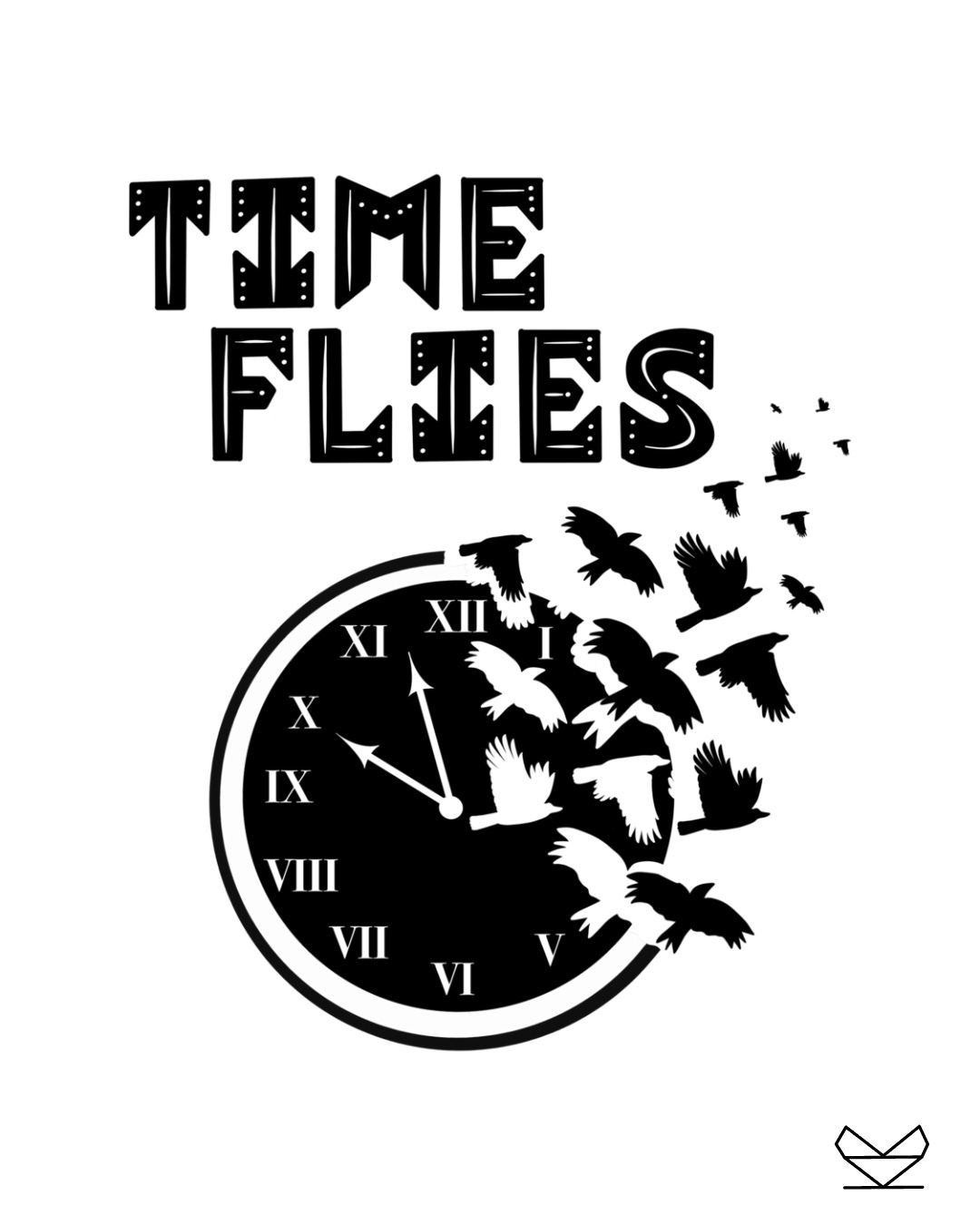
The image came to me immediately: a clock dissolving into birds, time literally taking flight and escaping. Not the happy, carefree flight of celebration, but something more melancholy—fragments of moments spreading their wings and disappearing into the distance.
I knew this needed to be stark. The emotional weight called for a silhouette design, something that matched the gravity of what I was feeling. No cheerful colors, no decorative flourishes—just the essential truth of time escaping rendered in simple, powerful shapes.
The clock and crows came together easily, birds getting smaller as they receded, carrying away pieces of time I could never get back.
Then came the words, and that’s where everything got complicated.
When Personal Stakes Meet Creative Struggle
“Time flies” should be simple to letter, right? It wasn’t.
I started with cursive—something that felt nostalgic, matching the bittersweet mood. But no matter how many times I redrew those flowing letters, they felt wrong. Awkward. Like they were fighting the illustration instead of supporting it.
I tried block letters. Then cursive for the first letters only. Each attempt felt further from what this piece needed to say.
Maybe it was because this illustration mattered so much. When you’re creating something therapeutic, something that’s helping you process a real emotion, the creative stakes feel higher. Every element has to earn its place.
After multiple failed attempts, I did the smartest thing possible: walked away. Knowing I’d return tomorrow with a fresh perspective.
The Breakthrough
When I came back, I abandoned everything I’d tried and experimented with a completely new lettering style. Drew the letters in black, added white details, and thought, “Better.”
Then a random idea: what if instead of adding white details, I used an eraser to create transparency? Let the background show through the letters themselves?
That was the moment everything clicked.
The funny thing? This new typography didn’t match the Roman numerals on the clock at all. Logically, I should have chosen lettering that echoed that classical feel. But sometimes logic isn’t the point. It looked right, it felt right, and in a piece about accepting that time escapes despite our best efforts to control it, maybe it was perfect that the letters refused to follow rules too.
Beauty in the Fleeting
Working on this illustration reminded me that some of our most meaningful creative work emerges from processing difficult emotions. The sadness of realizing those little kids are gone forever needed somewhere to go, and art became that container.
But here’s what surprised me: the creative process itself became a counterpoint to the melancholy. While the subject matter was about time escaping, the actual making became about time well spent. Experimenting with new techniques, playing with transparency effects, discovering approaches I’d never tried before.
It’s a reminder that moments are fleeting—including creative moments. That afternoon spent struggling with typography, that breakthrough with the eraser technique, that satisfaction of finally seeing the piece come together—all of it will become memory too.
Maybe that’s the real lesson. Yes, time flies away from us, carrying irreplaceable moments into the past. Yes, it’s heartbreaking to realize that the people we love are constantly changing, that versions of them disappear even as new versions emerge.
But it’s also beautiful. Beautiful because it reminds us that our current reality—whatever we’ve come to accept as normal—is temporary and precious. Beautiful because it pushes us to pay attention, to be present, to appreciate what we have while we have it.
The clock dissolves into birds not just as a symbol of loss, but as a reminder: this moment, right now, is flying too. The question is whether we’re awake enough to notice its wings.
Have you ever looked at an old photo and felt that pang of “that moment is gone forever”? What was it that made that particular slice of time feel so precious and irreplaceable? I’d love to hear about your own encounters with beautiful, escaped time.