

We’ve all heard it used as a casual insult: “Jack of all trades, master of none.” It’s meant to imply that to be good at many things is to be truly great at nothing.
But what if that’s only half the story? The full saying, often lost to time, is actually: “A jack of all trades is a master of none, but oftentimes better than a master of one.”
That second half changes everything. It reframes a supposed weakness as a strategic advantage. And in my experience, it’s the secret to building a creative life and business that doesn't just survive, but thrives.
From the time we're young, we're fed a specific narrative about success. It’s the 10,000-hour rule. It's the pressure to pick a hobby, narrow it down, get the grades, go to the right university, and land the job you’ll have for the rest of your life. It’s a straight line.
But my path has been anything but a straight line. Looking back, I’ve realized my professional life works in cycles. You could call it a seven-year itch.
I started out obsessed with flight. I had my glider pilot’s license at 16 and my private pilot’s license at 17. That led me to aerospace engineering, where I worked on the Canadarm for the Space Shuttle and even did a stint at NASA. After about seven years, the industry slowed, and I felt the itch. I did a complete pivot, taking my technical skills into the world of interactive design for museums and cultural institutions. I was a project manager, blending technology and art to build incredible exhibits.
A few years later, I moved from managing projects to managing the business itself, getting deep into streamlining process and operations. And then, right on schedule, the seven-year itch struck again. I left to start my own operations consulting company, which I’ve been running for seven years now.
And here I am, feeling that familiar pull. Alongside my consulting work, I’ve launched a new creative business, finally giving my love for illustration the space it deserves.
But a path like this comes with a nagging question: How do all these different pieces fit together? It’s one thing to live it, but another to explain how rocket science and museum exhibits all add up to a single creative identity. I was wrestling with that feeling of being a collection of disconnected stories when I stumbled upon a post from cartoonist Jason Chatfield sharing a drawing by Brendan Leonard. The illustration showed an old-school projector. In the wide funnel at the top, all of life’s inputs were being poured in—books, songs, movies, photos, experiences. All of it was churned through the machine of experience and skill to produce a single, focused beam called “YOUR ART.”
That drawing hit me hard. Society often makes you feel like you need to narrow that funnel, to pick one lane and stay in it. But I realized that my strength, my inspiration, and my art come from having the biggest funnel possible. All those seemingly disconnected worlds are the inputs that make my output unique.
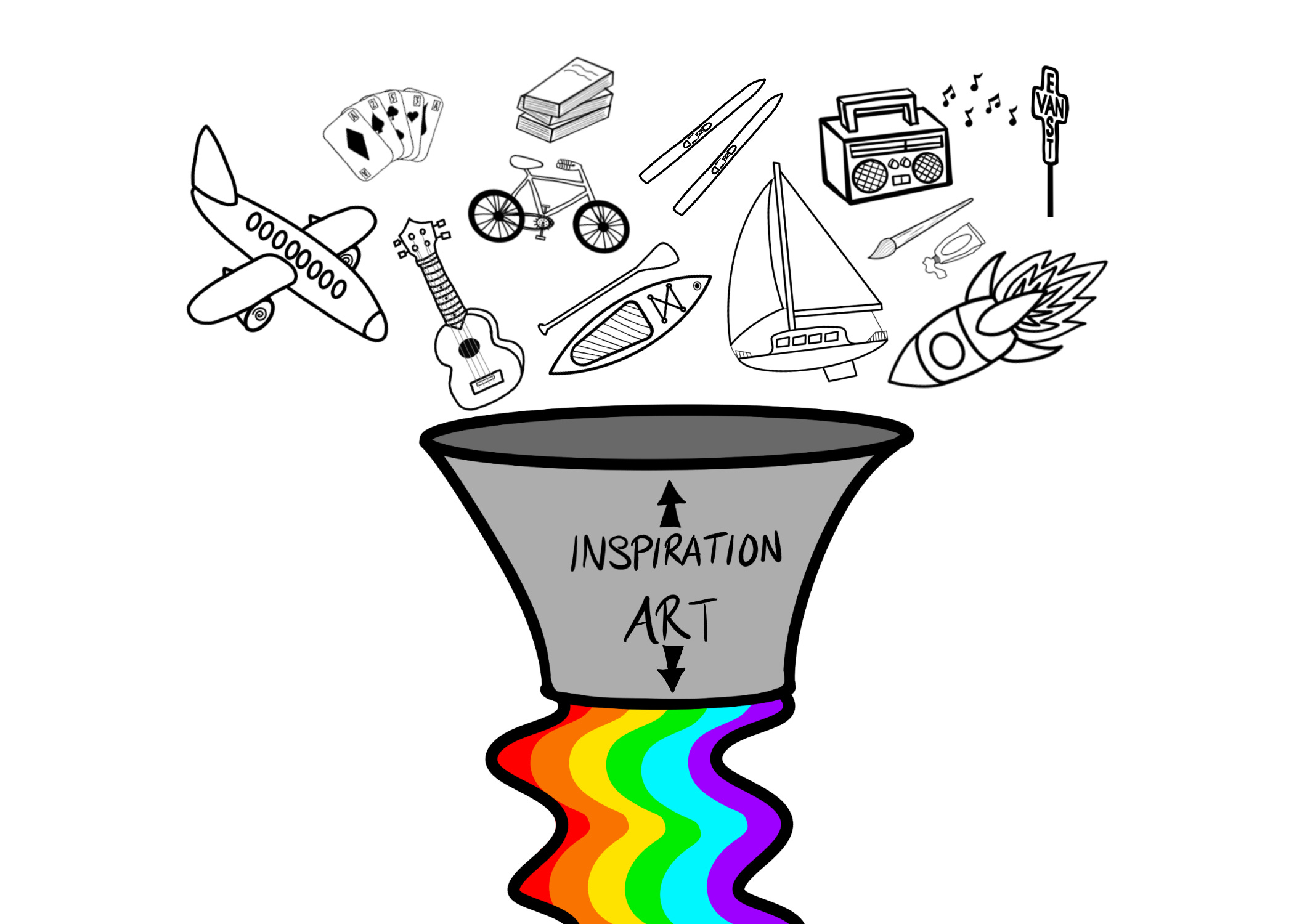
And my funnel isn't just filled by my resume. It’s packed with hobbies and obsessions, too. I’ve had my ‘learn the ukulele’ phase, my ‘sew all my own clothes’ phase, and my phase of being absolutely determined to perfect the world's best butter tart. (My husband’s colleagues were grateful beneficiaries of the many batches I deemed not quite good enough.) I love to travel, ski, paddle board, read, write, and I even took up sailing for a few years. These aren't distractions; they are just more inputs for the funnel.
The common thread through all of these pursuits—from rocket science to baking—wasn't a specific skill. It was a mindset. A willingness to try, not despite the fact that it’s difficult, but because of it. I get a thrill from the challenge of learning new things - I always say that my hobby is simply finding new hobbies. And because of that, I have never been afraid to suck at something. I fully accept that when I try something new, I will be a beginner - and probably a shockingly untalented one at that. This refusal to be deterred by the messy learning process is, I believe, the single biggest difference between dreaming and doing.
An Unconventional Superpower
So how does this "master of none" approach actually help you run a business?
First, you’re not just selling a skill; you’re selling your story. When I talk to new clients, I'm selling them on my unique blend of experiences—everything in my funnel. They know they’re getting someone who can think creatively and figure shit out when obstacles arise, because my entire career is proof of that. You are the sum of all your character traits plus your skills and life experiences. That’s what you’re selling: a unique perspective that allows you to do the job in a way only you can.
Second, In a world where most people fear change, those who embrace the unknown tend to thrive. The pace of change these days is terrifyingly fast, so being comfortable with being a beginner is a superpower. New tech, new platforms, new skills—no problem! These don’t feel like threats, they just feel like more interesting inputs for your funnel.
Putting Your Superpower to Work
Multi-hyphenate, Poly-math, Jack-of-all-trades, Generalist - whatever you call it, it's good for business. If you want to run your own business, you are signing up to be the CEO, the marketer, the bookkeeper, and the creative director - of course all of this is in addition to being the creator of whatever good or service you’re selling. Make no mistake about it, you have to be willing to become passably good at a wide variety of things to run a viable business. Give yourself the grace to be clumsy and make mistakes. Know that you’re not going to get it right the first time, and that’s the entire point.
Of course, this doesn't mean you have to do everything alone. A smart generalist also knows when to call in a specialist—like a lawyer to review a contract or an accountant to handle complex finances. But the foundational willingness to learn and try is non-negotiable.
So my real advice is this: Go suck at something. Seriously. The goals you're dreaming about are waiting on the other side of that initial, awkward, messy phase of being a beginner. Don't let the fear of not being good enough stop you from becoming great.
I'd love to hear from you in the comments:
What's one new skill you've been hesitant to try because of the fear of being a beginner? I'd love to hear what you're excited (or nervous) to learn next.
It sounds like you've done a lot of really interesting things over the years! And you're right, all those experiences come together into a unique blend of skills and perspective that you alone have.
Everything we do sets us up for what is next.