


I'll never forget the feeling of a dozen eyeballs on me in a stuffy breakroom.
I was a student on a work term, the most junior person by a long shot, working as a field service technician for a company that made high-tech lasers. These weren't sci-fi lasers; they were incredibly precise machines used to drill circuit boards for cell phones. And a critical unit had been down for days.
The client was furious despite our best attempts to fix the issue. By this point, all of our senior technicians—some with PhDs in electronics—had tried and failed to fix it. We had even flown an expert in from another country. But the machine remained stubbornly broken. The mood was tense.
In the small break room, the technicians debated the problem. I listened quietly and then asked, "Should I take a look at it?"
A few people chuckled. The message was clear: If we can't fix it, what makes you think you can?
"Well, nobody's had any success," I countered. "So why not have a new set of eyes on it?"
They shrugged. What was there to lose?
Twenty minutes later, I walked back into the breakroom. "It's up and running," I said.
Silence. Then disbelief mixed with outrage. "No way! There's no way you fixed it."
We all walked back to the machine, and there it was, humming along perfectly. They were stunned. And frankly, so was I, but for a completely different reason. The solution was surprisingly simple, so I couldn't figure out why it had stumped our best and brightest. I had simply followed the standard procedure for tuning the laser, which involves looking for visual cues—certain lines on a piece of paper—and then fine-tuning with a power meter.
As it turns out, the rule, drilled into every experienced technician, was that it was impossible for the laser's strongest point to be located on one of those visual lines. Their training had taught them to completely avoid those areas.
However, I wasn't aware of that rule. So, I wasn't trained to believe it was impossible.
I just tuned the laser to wherever the power meter gave me the strongest reading. When the highest reading happened to fall directly on one of those "impossible" lines, I didn't second-guess it. I just went with it. And it worked.
That lesson has stuck with me throughout my entire career: the fact that I did not firmly believe in a set of rules meant that I wasn't afraid to play outside of them. My inexperience gave me a freedom the experts didn't even know they were missing.
This brings me to my art.
I'm a self-taught artist, which is a nice way of saying I'm still very new to this. I'm building the plane while flying it—juggling a full-time job while taking online courses and slowly finding my way. And if I'm being honest, it can be nerve-wracking to admit how new I am. It opens the door to the question: Well, then, why should anyone buy your art?
My answer is the same now as it was as a student technician. My value isn't in being the most experienced person in the room; it's in not being afraid to try the "impossible" things.
For a long time, I struggled with traditional art techniques. When I took courses, my work would end up looking exactly like my instructor's. I was learning skills, but it didn't feel like me. The hidden cost of following the conventional path was my own authenticity.
So I started experimenting. The engineering side of my brain loves creating repeatable patterns. So, instead of using traditional brushstrokes for shading and detail, I started using patterns: tiny half-moons, cross-hatches, and diamond shapes. It's less realistic looking, but it feels authentically mine.
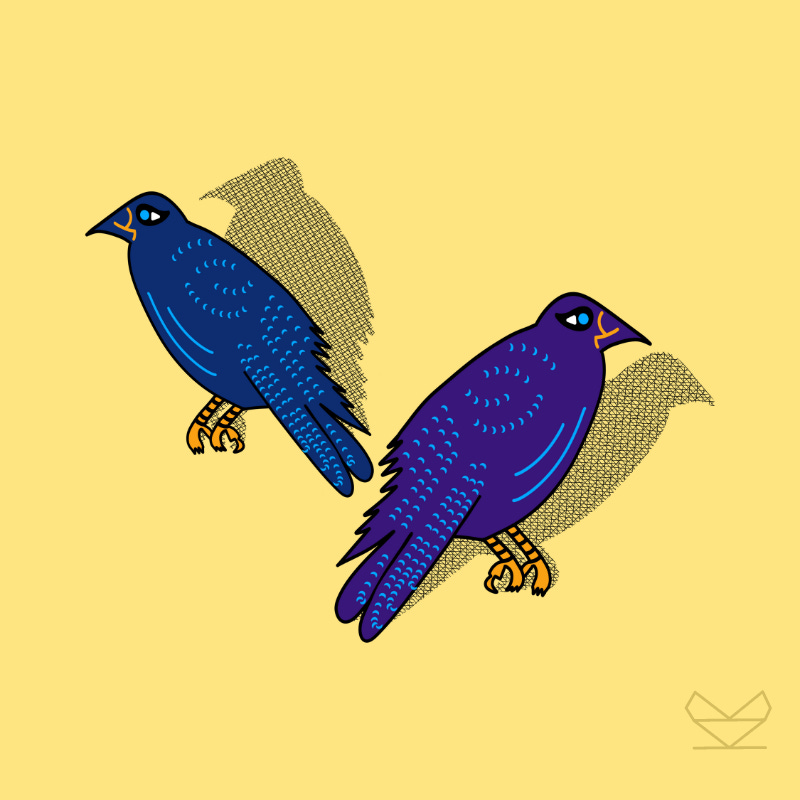
My lack of formal training allowed me to invent a system that made sense to me, without anyone telling me it was the "wrong" way to do it.
Of course, breaking the rules comes with its own set of challenges. I've discovered that patterns with very thin lines, like cross-hatching, look great on a canvas but tend to fade on a t-shirt after a few dozen washes. So after a bit of trial and error, I've learned to adjust the thickness of my lines.
But working through the challenges is well worth it, because the upside to creating my own approach is immense. What I thought would be a static set of patterns has become a living part of my creative process. Each new piece of art inspires me to design new patterns. My "unconventional" method has become a source of endless ideas.
The ultimate payoff for breaking the rules is a creative process that generates its own energy, freeing you from the need for outside approval. My goal is to hold onto that feeling I had in front of the broken machine—the freedom to find a solution where others are paralyzed by the rules.
That's the gift of the beginner. While a lack of expertise may hold you back in some areas, in others, it gives you a perspective that the experts may not even realize they're missing. And if you can learn to leverage that, it can become your superpower.
Now, I'd love to hear from you.
If you're an expert in your field, what's one "unbreakable rule" you secretly suspect might be holding you (or your industry) back?
Let me know in the comments below.
I love this story.... "hey guys, I fixed it!"
The part I left out of the story, was that one of the senior technicians was genuinely mad at me for "showing him up". He wouldn't talk to me for two straight days, which made carpooling to & from work an awkward but hilarious (to me, at least) experience.
He did eventually put his ego away & apologize.